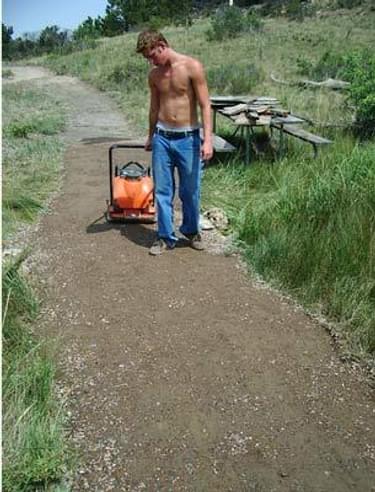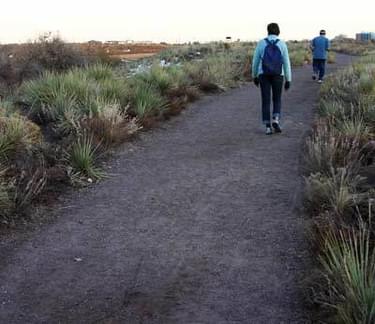

Crushed stone trails provide a user-friendly, all-season surface for all types and ages of visitors, including strollers, wheelchairs, and road bikes.
by Tony Boone, COO, Timberline TrailCraft
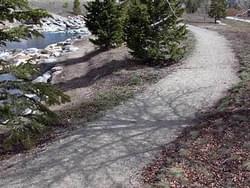
Arrowhead Trails, Inc. has built over 500 miles of natural surface trails since 1995. Their specialty is machine-built, 48" wide trails for mountain bikers, runners, and hikers. Even though 95% of their new construction is with native soils, they are receiving more requests for soft surface, accessible trails built with 3/8" minus crusher fines; or crushed stone, cinder or rock dust as it is called in other areas.
Whether it's a trail to school in an urban area or a core loop of your open space trail system, crushed stone trails provide a user-friendly, all-season surface for all types and ages of visitors. If built properly crushed stone trails can meet the American with Disabilities Act (ADA) Accessibility Guidelines. Accessible trails often service an incredibly diverse range of visitors including: hikers, bikers, runners, strollers, mobility impaired, visually impaired, and wheelchairs.
Accessible crushed stone trails should be designed and constructed at grades less than 8% grade to promote accessible use. Trail tread grades of up to 10% for short distances are allowed but difficult for most visitors seeking an ADA trail to enjoy. Overall trail grade averages of less than 6% will provide the most user-friendly experience and offer the most sustainable natural trail surface if compacted crusher fines are to be used.
Many parks and open space areas are constructing accessible, soft surface trails into their trail systems. In areas with long periods of rain or snow and clay or silt-based soils, park infrastructure trails are often surfaced with concrete or crusher fines to minimize muddy trail conditions and reduce facility maintenance.
High clay content soils typically cause trails to be slick and muddy when wet. They also take longer to dry out since their extra fine particles don't give up water easily. Trail treads surfaced with 4-6 inches of compacted fines over a landscape fabric can eliminate many of the problems associated with soils and climate. Landscape fabrics or geotextiles are also key to preventing vegetation from growing into the trail and preventing commingling of the crusher fines with the natural soils.Since crusher fine trails usually cost in excess of $10.00 per linear foot it is important to construct them right the first time. Success relies on getting the right materials and installing them correctly. Mistakes often result in poor compaction, soft surface conditions, non-accessibility, and inevitably costly repairs.
Crusher fines in their purest form have no soil mixed in, they are pure crushed stone. Gravel and crusher fines differ from one another in that gravel is screened to remove the fines which contain the natural binders/cements. Gravels remain loose because of dead air or pore space within the matrix which allow them to drain well and resist compaction.
Crusher fines retain their inherent soil cements and binders which promote soil compaction. Fines that contain too many rounded particles (like some decomposed granites) are more difficult to interlock and often yield a loose and unconsolidated surface. Angular particles like andesite, dolomite, and certain types of granite can easily be wetted and compacted to meet the ADAAG.
A good indication of the strength of a rock binder is the hardness of the parent rock. The harder the source rock, the stronger the binders will be. Crushed rock contains the original rock cements and binders within the rock dust. These binders, combined with water and then compacted with a vibratory roller or plate compactor should produce a solid, compacted surface that resists significant deformation from hiking boots and mountain bike tires. We frequently see baby strollers and road bikes using our crushed stone trails.
A sieve analysis for trails, using 3/8" minus crusher fines, typically describes the material with the following specifications:
If the surface of a crusher fines trail becomes loose and uncompacted over time it can often be wetted, reshaped and recompacted provided the fines have not sifted to the bottom and the larger particles floated to the top. Poor compaction can be the result of a variety of influences that include improper wetting and compacting during installation, lack of particle angularity, trail grades greater than 6%, and/or inadequate amounts of natural soil cements or lack of fines in the parent material that act as binders. Some “refreshing” of trail surfacing material is required on a routine basis. Trail tread grades over 6% will require significantly more maintenance since they tend to unravel or erode faster.

Tony Boone is a pioneer in the evolution and art of planning and creating sustainable trails for mountain bikers, hikers, runners, and equestrians, having completed over 400 successful trail projects encompassing fifteen U.S. states and nine countries. His accomplishments include the first official mountain bike patrol in Colorado in 1989, training eight International Mountain Bicycling Association (IMBA) Trail Care Crews (1997-2011), inspiring and conducting mechanized trail dozer training for IMBA Trail Solutions (2001), and contributing to three IMBA books: Trail Solutions: IMBA’s Guide to Building Sweet Singletrack, Managing Mountain Bikes: IMBA’s Guide to Providing Great Riding, and Bike Parks: IMBA’s Guide to New School Trails. During his career, Tony has taught over 3,000 students worldwide the art of sustainable trail design, construction, and management.
Currently, Tony is the owner of Tony Boone Trails and the Business Development Specialist for Timberline Trailcraft. Tony holds a Bachelor’s of Science degree in Animal Science, and a Master of Education focused in Outdoor Adventure Recreation.
Contact: [email protected]
Building a Permeable, Low Maintenance Recreational Trail Along a Shoreline
posted Apr 7, 2023
In 2009, the city of The Colony planned to build a recreational trail (10 foot-wide, 3.5 mile pathway) that would run along the lake’s shoreline, contouring to its natural shape and providing residents with a picturesque route for outdoor activities such as walking, jogging, and cycling. The city selected the GEOWEB® Soil Stabilization System due to its flexibility to conform to curves, surface permeability, and low maintenance design.
posted Jul 15, 2022
This research investigated the influence of several use-related, environmental, and managerial factors on soil loss on recreational trails and roads at Big South Fork National River and Recreation Area, a unit of the U.S. National Park Service.
All-Terrain Vehicle Sustainability Assessments
posted Jul 15, 2022
The sustainable management of ATV use is an expensive proposition requiring careful design, construction, and maintenance of ATV trails.
posted Jul 15, 2022
This research assessed the condition and sustainability of the trail system at Tallgrass Prairie National Preserve, a National Park Service unit that partners with The Nature Conservancy (TNC) in the management of this unit.
26,030 views • posted 05/03/2018